"An Attorney near me" - Cape Town legal concierge
lawyer@capetownlawyer.co.za or WhatsApp
Administration of Deceased Estates in South Africa
When a loved one passes away, the process of managing and distributing their assets is prescribed by the Administration of Estates Act of 1965. This process, known as winding up the estate, is legally complex, highly administrative, and requires strict adherence to statutory timelines.
Whether you have been nominated as an executor or are a family member trying to understand the road ahead, this guide covers everything you need to know about the deceased estate administration process in South Africa.
Overwhelmed by the paperwork?
Winding up an estate requires dozens of specific steps. We have built a free, interactive checklist to help you track exactly what needs to happen and when.
📋 Use the Free Estate Wind-Up ChecklistEmail lawyer@capetownlawyer.co.za for professional legal guidance with the administration of a deceased estate in Cape Town.

1. The Role of the Executor
When a loved one dies, the Executor nominated in the deceased’s last will and testament must be contacted. It is best to ensure that an attorney experienced in estates is nominated as executor, as the statutory requirements are stringent.

If an inexperienced layperson is appointed as executor, they will usually appoint legal specialists (agents) to assist them, including:
- Conveyancers to handle the transfer of property out of the deceased estate.
- Attorneys to manage the formal winding-up process and deal with the Master of the High Court.
- Litigators, should there be any disputes over the will.
To legally authorise these specialists, the executor signs a special power of attorney, allowing the lawyers to execute the administrative work on their behalf.
What if the appointed executor dies?
If the appointed executor dies, their office is terminated automatically. A new executor must be nominated by the heirs and must apply to the Master to be officially appointed.
2. Estate Size: Section 18(3) vs. Letters of Executorship
The procedures, documents, and appointments required to report an estate depend entirely on the total gross value of the deceased's assets.
- Estates under R250,000 (Section 18(3)): The Master does not appoint a formal Executor. Instead, a "Master’s Representative" is appointed. They are authorised to administer the estate without following the full, lengthy procedure set out in the Act. It is a simpler and quicker process.
- Estates over R250,000: The Master issues formal Letters of Executorship. The appointed Executor must follow the full statutory winding-up process, including advertising to creditors and drafting a formal Liquidation and Distribution account.
Note: If an estate is very small, corporate executors (like banks) often decline their nomination, leaving the family to nominate a new representative.

3. Gathering Assets & Liabilities
The executor's first major task is to gather comprehensive information regarding all of the deceased’s assets and debts. This includes bank accounts, vehicles, and share portfolios (see Computershare deceased estate resources).

4. The Step-by-Step Winding Up Process
- Nomination: If the deceased left a Will, it usually nominates an executor. If there is no Will (intestate), the heirs must nominate an executor (an "executor dative") by completing the Nomination to Act as Executor form. A J192 Affidavit detailing the next-of-kin must also be submitted.
- Application to the Master: The executor applies for Letters of Executorship. This requires submitting the Death Certificate, original Will, a preliminary inventory, and an Acceptance of Trust.
- Advertising for Creditors: Once the Letters are issued, a statutory notice must be published in the Government Gazette and a local newspaper, giving debtors and creditors 30 days to lodge claims.
- Liquidation and Distribution (L&D) Account: The executor drafts the L&D account detailing all assets, liabilities, administration costs, and heir distributions.
- This account is submitted to the Master, who takes roughly two months to examine it and issue any queries.
- Once approved, the the executor must publish a section 35(5) notice in the Government gazette and advertised in local press, to inform the public that the L&D account has been approved and is available for viewing.
- A copy of the L&D account is placed at the Master's office (and, at the local Magistrate's court if the deceased ordinarily resided in a district or town different from the one where the Master of the High Court's office is situated); where it must lie open for public inspection for 21 days (allowing for formal objections from creditors and heirs). Per Circular 6 of 2025, this advertising may now be viewed online.
- After the 21 days have passed, the Magistrate's Court will notify the Master whether any formal objections were lodged. The executor must respond to all formal objections, and the Master must make a ruling before the process can continue.
- Finalisation: If there are no objections, the executor pays the creditors, distributes the remaining inheritance to the heirs, and transfers fixed property. Distributions must occur within 2 months of the 21 days inspection period closing.
- Proof of all finalised payments is submitted to the Master to close the estate; in the form of bank statements, transfer deeds and receipts.
- Once the Master is satisfied, it issues a J183 form and formally discharges the executor.
5. Deceased Estate Administration Costs
Winding up an estate incurs several statutory and professional costs:
- Executor’s Remuneration: The statutory maximum is 3.5% (plus VAT) on the gross value of the estate assets, and 6% (plus VAT) on any income accrued after death. This fee is often negotiable.
- Estate Duty: Payable to SARS. Currently, Estate Duty is levied at 20% on the dutiable value of an estate up to R30 million (after the R3.5 million basic abatement), and 25% on values exceeding R30 million. Calculate your exact Estate Duty liability here.
- Master’s Fees: Calculated according to a statutory tariff based on the estate's value, capped at a maximum of R7,000.
- Advertising Costs: Approximately R1,200 for mandatory newspaper and Government Gazette notices.
- Additional Expenses: Conveyancing costs, bank charges, and potential tax consultant or litigation fees.
6. Dealing with the Master of the High Court
The Master supervises the entire winding-up process. Jurisdiction is determined by where the deceased lived for the 12 months prior to their death. There are local Master's Offices across all provinces (e.g., Cape Town, Pretoria, Johannesburg, Bloemfontein).
System Delays and Inefficiencies
Service levels differ drastically per office. Delays are common due to understaffing, digitisation projects, and historical backlogs caused by COVID-19 and ransomware attacks. Furthermore, the Master's Office must frequently interface with the Department of Home Affairs (e.g., to verify marital status or next-of-kin), which creates further bottlenecks.
Tracking an Estate: Deceased estates can be tracked online. The Master’s Office portal allows you to search by ID number, surname, or estate file number to retrieve the estate's status and Unique Reference Number (URN).

The Cape Town Master's Office
Situated in the Dullah Omar Building at 45 Castle Street, Cape Town. Office hours are 08:00 to 13:00. You can email them at MasterCapeTown@justice.gov.za or call +27 21 832 3000. Please note that this office is frequently understaffed, requiring significant patience.
7. Timelines: How Long Does It Take?
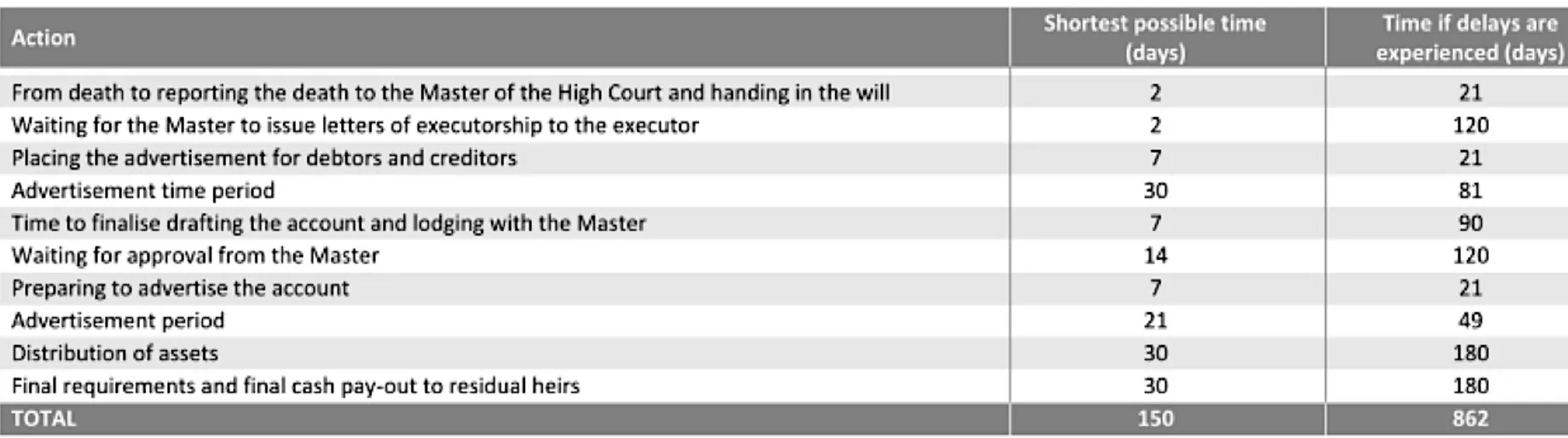
Because of statutory advertising periods and Master's Office processing times, winding up an estate is not a quick process. A straightforward estate generally takes between 9 and 15 months.
8. Additional Complications
Insolvent Estates
If the deceased's debts exceed their assets, the estate is administered in terms of Section 34 of the Administration of Estates Act, which fundamentally alters how creditors are paid.
Unclaimed Inheritances & The Guardian's Fund
Inheritances due to minors (under 18) are paid directly into the State's Guardian’s Fund unless a testamentary trust was explicitly created in the Will. Monies due to untraceable heirs are also deposited here. If funds are not claimed within 30 years, they are forfeited to the State.
Deceased Estate Fraud
A growing risk in South Africa is the impersonation of executors. Criminals forge Letters of Executorship to redirect bank payments. For example, in May 2025, Standard Bank was ordered to repay over R2.1 million to an estate after processing transfers authorised by a fraudulent executor.
Frequently Asked Questions
- Is there an ombudsman for deceased estates in South Africa?
There is no specific ombudsman. The Master of the High Court supervises the administration. Disputes should be directed to the local Master's Office. If unresolved, complaints can be escalated to the Chief Master’s office in Pretoria (chiefmaster@justice.gov.za). If a delay is caused by a bank, you can lodge a complaint with the Ombudsman for Banking Services (info@nfosa.co.za). - Can you sue a deceased estate?
Yes, legal action can be instituted against the estate itself. The executor acts as the legal representative in defending these claims. - How does this compare to UK Probate?
If you are familiar with UK law, the South African process of applying for Letters of Executorship is highly analogous to the UK process of applying for a "Grant of Probate." Both require court supervision to authorise the estate administrator.
Family, Estate & notarial legal services
Deceased Estate Information
If a relative has died, perhaps without a will, and you are unsure of what to do:
- Report deceased estate to the Master online
- Steps to take when your parent dies without a will.
- Lawyers in Cape Town specialising in deceased estates.
- Administrators in Cape Town for deceased estates.
- Letter of executorship requirements in South Africa.
- J192 form - next-of-kin (if no will)
- Nomination to act as executor (if no will)
- J190 form assistance
- Administration of deceased estates in South Africa.
- Property:
- Inheritance and child maintenance obligations.
- Intestate Succession Act
- Tracking deceased estates
- Death of a spouse before divorce is finalised
Wills
- How to write a will.
- Example of a last will and testament.
- Get your will drafted for free (by a lawyer).
- List of lawyers that draft wills in Cape Town.
- Consider updating your will when these events occur:
- when divorcing; to avoid your ex-spouse possibly inheriting everything.
- death of somebody mentioned in your will,
- the birth of a child you may want to include in your will,
- marriages
Connect with a Deceased Estate Expert today
Deceased Estate discussion forum
Note that this is a public forum - exercise caution before acting on info and use at own risk. Anybody may ask and answer, and you don't know what their level of expertise is. No information on this website should be acted on without first consulting with a lawyer to test its validity. Do not share private details here.